Why enterprise SaaS is racing to put its database inside your LLM.
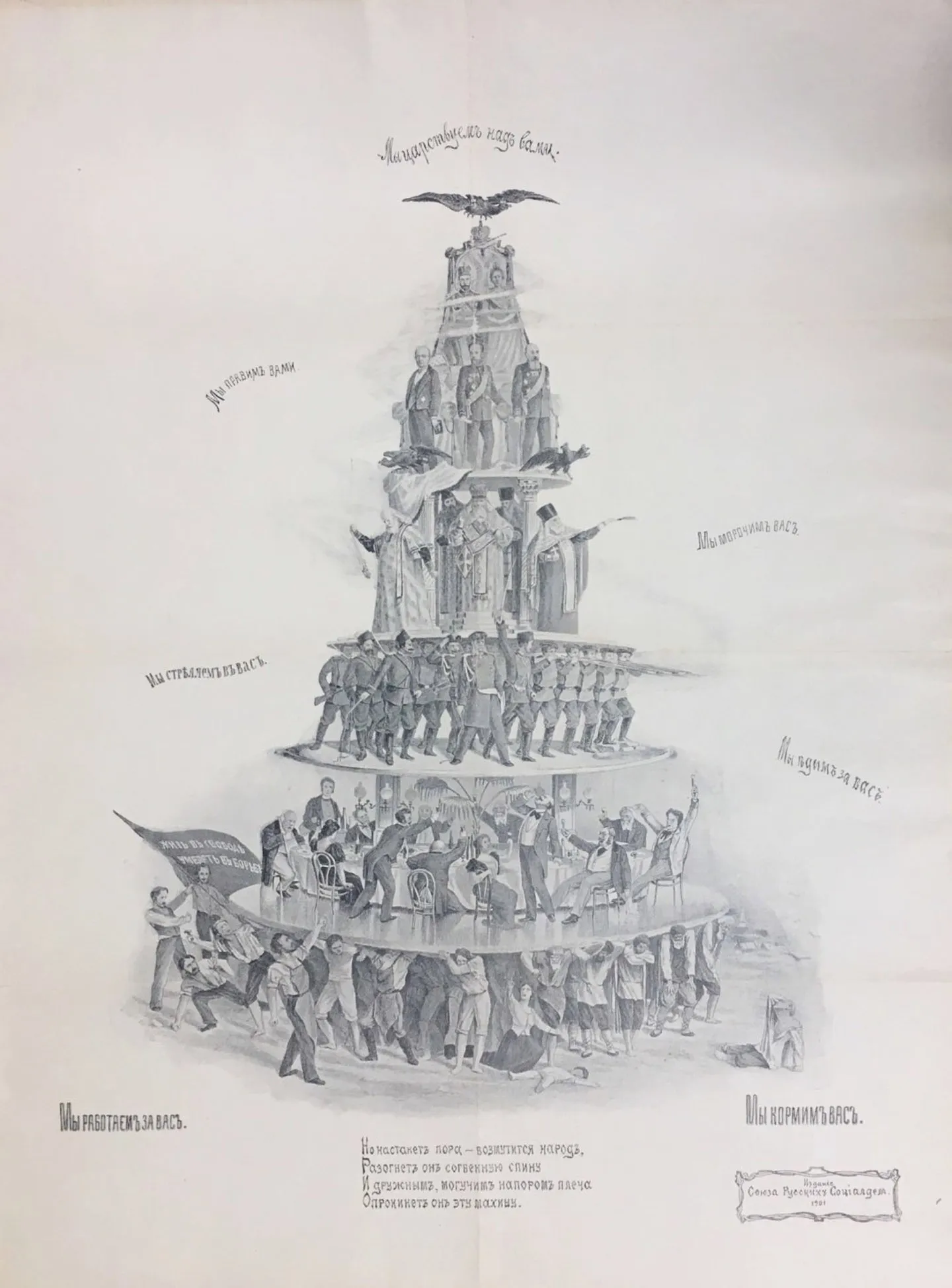
Industrial Worker, Pyramid of the Capitalist System (1900). Tiered structures where each floor pays rent to the foundation underneath it.
I recently sat through an enterprise roadmap presentation with a major enterprise CRM vendor. The account team was eager to demonstrate their newest multi-million-dollar product releases.
Ninety percent of the presentation was a product specialist showing us Slackbot.
Not complex relational pipelines. Not custom Apex triggers. Not new Lightning web components. Just an agent conversational interface that retrieves a contact record, drafts an email follow-up, and updates an opportunity stage from a chat window.
The lines between the CRM, enterprise search engines (like Glean), and general-purpose LLM orchestration layers have blurred into complete convergence.
And then Salesforce announced their deep integration with Claude, effectively declaring that enterprise users might never need to open the traditional web application again:
“This idea that people are going to vibe-code their own CRM is probably not going to happen anytime soon. But what we are seeing is that people do want to vibe-code their own CRM workflows, and that’s what we’ve enabled. You’re vibe-coding against trusted, governed Salesforce data.”
The industry applauded this as an act of customer-centric UI modernization.
Look closer at the balance sheet. It isn’t UI design. It’s the economic circle of life.
THE SAAS REVENUE CEILING:
[Seat-Based License: $150/user/mo] ──> [User clicks 10,000 times inside UI] ──> Incremental Revenue: $0.00

THE TOKENIZED MARGIN TOLLBOOTH:
[Headless Agent Query] ──(API Call)──> [MCP Bridge] ──(Context Window Expansion)──> [$$$ Per-Token Billable Meter]
The Seat-Based Revenue Ceiling
Traditional enterprise SaaS has hit a wall: seat-based licensing.
If an enterprise client pays $150 per user per month, Salesforce makes the exact same revenue whether a sales director clicks inside a contact record three times a day or three thousand times a day. Enterprise vendors tried to make storage overages a growth driver, but companies simply purge old attachments or export cold records to cheap S3 buckets.
Clicking inside a graphical web interface produces zero incremental revenue.
Headless agent usage completely flips that equation.
When an autonomous agent queries an enterprise system via an MCP connector, it doesn’t just fetch one row. It loads schema manifests, reads field definitions, fetches parent accounts, pulls recent activity notes, and runs multi-turn classification.
A single human question in chat (“Summarize open pipeline risks for the Northwest region”) triggers twenty API calls, consuming hundreds of thousands of input and output tokens across the bridge.
In a revenue-sharing model between model providers and enterprise data platforms, more headless automation equals more billable meter ticks.
The Illusion of Vibe-Coding the Enterprise
A common Silicon Valley narrative over the past year was that autonomous coding agents would destroy legacy enterprise software: “Why pay millions for Salesforce or Workday when two junior developers can vibe-code a custom CRM on Supabase over a weekend?”
Anyone who has worked in enterprise IT infrastructure for more than six months knows why that doesn’t happen.
Building a CRUD interface for customer records is trivial. What you are actually paying enterprise software companies for is the unsexy, invisible foundation:
- Complex multi-tiered role hierarchies and territory management.
- Granular column-level encryption and audit trails.
- SOC 2 Type II compliance, ISO certifications, and GDPR data deletion handlers.
- Provenance tracking when an account gets disputed in litigation.
Startups don’t want to maintain that infrastructure. Enterprise CIOs won’t risk their jobs on an unvetted Postgres database deployed by an intern.
The compromise that won the market is vibe-coding on top of enterprise data: You don’t replace the database of record. You keep the governed, audited data fortress. But you rip the clunky, bureaucratic graphical front-end off and replace it with conversational agents and targeted micro-frontends.
The Margin Shift
The winners of this shift aren’t the companies building flashy dashboard skins. The winners are:
- The Model Providers: Selling high-throughput inference tokens for every headless lookup.
- The Systems of Record: Transforming static seat licenses into high-margin API consumption meters.
Honest Caveats
- Token Bill Shocks: Headless agents querying large schemas can burn thousands of dollars in API credits overnight if queries aren’t tightly cached and bounded. The seat license was predictable; token consumption is an operational variable that demands strict billing rate limits.
- Latency Overheads: A well-indexed SQL query returns in 20 milliseconds. An LLM agent doing multi-turn MCP lookups to answer a question takes 4 to 12 seconds. For high-speed transaction entry, traditional interfaces still win on raw throughput.
Enterprise software didn’t die. It just found a way to charge you for the oxygen its robots breathe.